The Trusted Insurance Data Foundation: How Trusted Data Becomes Intelligence in Action
Collecting Data is Just the Start
Insurers have no shortage of data. The challenge is that more data does not automatically create a clearer view of the business. A trusted insurance data foundation provides the governed layer that brings insurance data together, preserves the context that gives it meaning, and makes it usable across reporting, analytics, AI, and operational workflows.
For insurers, that means more than centralizing information. Policy, billing, claims, rating, underwriting, distribution, reinsurance, customer, and external data all describe different parts of the insurance business. To support confident decisions, those sources need to be connected, consistent, and governed so they provide a usable insurance context.
A trusted insurance data foundation turns fragmented operational data into trusted, governed insurance context that analytics, AI, and core operations can use to understand the business and move work forward.
Duck Creek Clarity Data Foundation is Duck Creek’s trusted insurance data platform. It unifies core, third-party, and external data to provide trusted, governed insurance data—and the insurance context analytics, AI, and the Intelligent Core of Insurance need to understand the business and support informed action.
When Data Is Fragmented, So Is the Business View
Insurance data rarely lives in one place. It is distributed across systems, teams, and processes, making it difficult to establish a trusted, shared view of the business.
Policy information often lives in one system, claims history in another, and billing activity somewhere else—alongside underwriting, distribution, reinsurance, and third-party data. Years of acquisitions, legacy systems, and point solutions can compound that fragmentation.
The result is familiar: teams extract, reconcile, interpret, and reassemble data before they can use it. That slows reporting and analysis, creates inconsistent definitions, increases dependence on technical resources, and makes it harder to establish a common view of the business.
The stakes become greater as insurers expand their use of AI.
Insurers cannot scale AI or build more intelligent operations on fragmented, ungoverned data. As AI takes on a more active role in insurance workflows, it needs reliable data and a clear understanding of the policy, claim, risk, customer, and business context involved.
AI does not simply need access to more data. It needs trusted insurance data and the context to understand what that data means.
A trusted insurance data platform creates that common layer, preserving the insurance context that helps people, analytics, and AI work from a consistent understanding of the business.
Go Deeper: Why Data Readiness Is the Foundation of AI in Insurance Read the article
Why Reporting is No Longer Enough
Traditional data environments focus on collecting information for reporting and retrospective analysis. Those capabilities remain important, but they can leave teams looking backward when the business needs trusted information to understand what is happening now and decide what to do next.
A trusted insurance data foundation needs to preserve the structures, relationships, and business definitions that give insurance data meaning. It should connect information across functions, apply consistent definitions and governance, and make that information usable by business intelligence, advanced analytics, AI, and downstream applications.
A trusted insurance data platform is not simply a data lake, warehouse, reporting layer, or generic data platform. It provides trusted, governed insurance data with the models, relationships, definitions, and business meaning needed to support reporting, analytics, AI, and operational use.
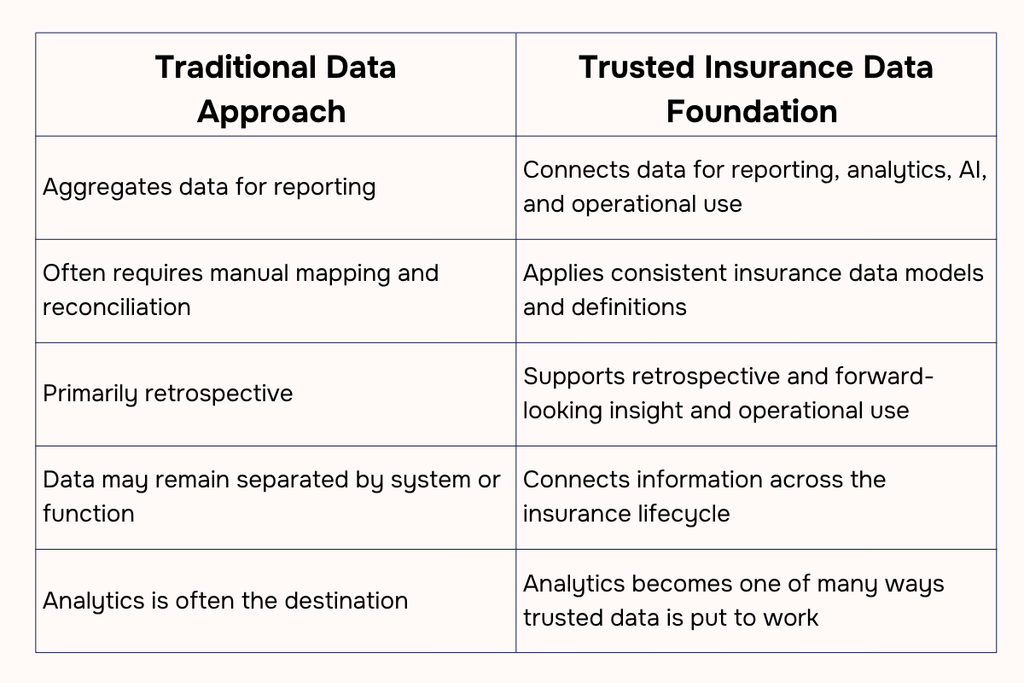
The shift is from collecting insurance data to providing trusted, governed insurance data that gives analytics and AI usable insurance context.
Unify Insurance Data Across Systems
Insurance decisions rarely depend on information from one application. Yet bringing that information together often requires teams to extract, reconcile, and interpret data across multiple systems before they can use it.
Clarity brings together data from Duck Creek Policy, Billing, Claims, and Rating alongside third-party and external sources in a common, governed environment. Consistent insurance data models and definitions reduce reliance on siloed extracts and manual data stitching.
The same trusted insurance data platform can serve multiple business functions, reports, analyses, and use cases.
For insurers, the architecture is open. Core, third-party, and external data come together in Clarity, making trusted, governed insurance data and consistent insurance context available across the broader technology and data ecosystem.
One cloud-native trusted insurance data foundation supports many decisions without requiring every decision to begin with another data integration project.
Go deeper: Duck Creek Clarity Data Foundation
Turn Insurance Data into Business Intelligence
Trusted data becomes valuable when people can use it to understand what is happening and decide what to do next. When every new question requires another extract, reconciliation, or technical request, that insight can be difficult to reach.
Clarity provides insurance-specific reporting, configurable dashboards, and self-service analytics across core insurance operations. Business users can work with consistent information around underwriting, claims, finance, operational performance, and other insurance priorities without relying solely on disconnected reports from individual systems.
Clarity includes pre-built insurance business intelligence and allows insurers to configure dashboards, reports, and KPIs around their own organization and lines of business.
That changes the role of analytics. Instead of spending as much time locating, reconciling, and preparing information, teams can spend more time interpreting what it means and deciding how to respond.
The goal isn’t more reporting. It’s less distance between the data, the insight, the decision, and the action.
Trusted AI Starts with Trusted, Governed Insurance Data
As AI moves from generating insights and recommendations to participating more directly in insurance workflows, insurers need confidence not only in the intelligence itself, but in the data and context informing it.
An AI agent can only reason effectively about a policy, claim, risk, or customer if the underlying information is reliable, consistent, governed, and understood in the context of insurance.
The more responsibility AI takes on, the more important the data behind it becomes.
An underwriting agent may need submission information, prior policy history, claims experience, appetite, pricing, third-party risk information, and authority context. A claims agent may need policy and coverage information, loss details, prior claims, enrichment data, fraud signals, and workflow context.
AI doesn’t just need more data. It needs trusted insurance data and the context to understand what that data means.
Clarity provides the trusted, governed insurance data that contributes essential insurance context for analytics, machine learning, and AI to understand the business. It connects and governs curated insurance information without making Clarity itself responsible for AI decisions or actions.
And trusted data is only one part of Trusted AI. Governance must also extend to how AI is deployed, what authority it has, how decisions and actions are traced, and where human judgment remains involved. Those responsibilities extend into the Duck Creek Agentic AI Platform and the broader Intelligent Core of Insurance.
Duck Creek Clarity Data Foundation provides trusted, governed insurance data. The Duck Creek Agentic AI Platform governs how agents reason and operate. The Intelligent Core of Insurance connects intelligence with the people, workflows, and core systems that execute the work.
Go deeper: Responsible AI Governance in Insurance: How Duck Creek Sets the Standard
Prepare Insurance Data for Agentic AI
Data readiness for Agentic AI starts before an agent acts.
Insurance information needs to be connected across relevant sources, structured around consistent business definitions, governed appropriately, and available with the context AI needs to interpret it.
Clarity provides trusted, governed insurance data, including the consistent business definitions, quality standards, and traceability that give analytics and AI usable insurance context.
Duck Creek’s Agentic AI strategy builds on that readiness. Its Agentic AI Platform supports agents and orchestration across insurance workflows, while applications such as Duck Creek Send Underwriting, Agentic First Notice of Loss, and Agentic Product Configurator apply intelligence to specific areas of insurance work.
Go deeper: Insurance Big Data & Analytics Trends in 2026: Turning Data into Strategic Advantage
Keep Insurance Data Governed and Trusted
Effective insurance data governance starts with knowing that the information used across the business is consistent, controlled, and traceable.
With a standardized, insurance-native data model, Duck Creek Clarity Data Foundation reduces reconciliation issues between core systems and helps ensure the metrics used by underwriting, claims, and finance teams are accurate and aligned. Built-in data quality checks and governed pipelines help eliminate errors caused by manual processing or fragmented data sources.
For global carriers, Clarity enables consistent governance across countries and regions—supporting trusted data, transparent lineage, and reliable enterprise reporting without sacrificing local flexibility.
Those capabilities matter for reporting and analytics, but they become even more important as data is increasingly used by AI across insurance workflows.
That governance helps insurers understand where information came from, apply consistent business definitions, manage access, and give people, analytics, and AI a trusted understanding of what the data means.
But governance responsibilities do not stop with the data. As AI moves into operational workflows, agent authority, human oversight, decision traceability, and explainability must be addressed at the AI and orchestration layers as well.
Work with Existing and Third-Party Technology
Trusted, governed insurance data cannot stop at the boundaries of the core. Clarity brings together data from Duck Creek applications, third-party systems, and external sources.
That openness matters because insurers rarely operate within a single technology environment. Core platforms, distribution technology, external data providers, analytics tools, and specialized applications all contribute information the business may need.
Clarity connects that information in a common, governed environment, preserving the insurance context those data sources contribute without requiring every source to originate within Duck Creek. Duck Creek’s broader architecture also includes an Integration Hub with insurance-ready APIs and prebuilt connections for linking core systems, partners, and third-party applications.
The goal is not to move every system into one stack. It is to make the information across that ecosystem more usable as trusted insurance data.
Go deeper: Connect anything, change everything
Do Insurers Need to Complete Core Transformation Before Modernizing Their Data?
No. Insurers should not have to wait for a multi-year core transformation or the replacement of legacy insurance systems to begin getting more value from their data. A data foundation can become part of the transformation before core modernization is complete.
Country-Wide Insurance provides a useful example. The New York insurer selected Clarity to strengthen its data and analytics capabilities ahead of its broader Duck Creek cloud transformation.
Go Deeper: Country-Wide Insurance Selects Duck Creek Clarity to Drive Insight-Led Growth
Support Different Insurers, Markets, and Operating Models
The same data challenge appears at different scales.
A regional insurer may need a consolidated view across a focused set of products and operations. A global specialty insurer may need to work across entities, currencies, geographies, reinsurance structures, and financial processes.
Clarity’s cloud-native architecture and configurable insurance data model help insurers maintain trusted, governed insurance data and consistent insurance context across entities, currencies, geographies, and operating models—without requiring a bespoke data platform.
For global insurers, Clarity supports multi-entity, multi-currency analytics and consolidated reporting across North America, EMEA, and APAC—while helping organizations meet regional and regulatory reporting requirements with confidence.
Customer adoption illustrates that range. Country-Wide selected Clarity as part of a New York-focused P&C transformation, while global specialty insurer Fortegra selected Clarity with Duck Creek Reinsurance as part of a broader finance transformation.
The insurance context available to analytics and AI should reflect how the insurer’s business actually operates—not force the business into the structure of a generic data platform.
Go deeper: Fortegra Selects Duck Creek Reinsurance and Clarity to Support Strategic Growth
The Business Outcomes of Trusted, Governed Insurance Data
The value of trusted insurance data isn’t measured by how much information is stored. It’s measured by what the business can understand and do better when data carries the context needed to put it to work.
Customer example: Country-Wide Insurance selected Duck Creek Clarity to strengthen its enterprise data and analytics capabilities as part of its digital transformation. By unifying policy, billing, claims, and external data, Clarity will help its teams access real-time insight, support smarter decisions, and streamline operations across the business.
Operational Visibility
Bring information across policy, billing, claims, distribution, and external sources into a more consistent view of insurance performance.
Faster, More Informed Decisions
Give underwriting, claims, finance, and operational teams more timely access to consistent information and insurance-specific analytics.
Less Manual Data Work
Reduce the effort involved in extracting, reconciling, and preparing fragmented data for reporting and analysis.
Accessible Insurance Analytics
Give business users configurable dashboards, pre-built insurance intelligence, and self-service analytics without making every question dependent on a new technical request.
Stronger Data Governance
Apply more consistent definitions, quality controls, lineage, and access across the data used for reporting, analytics, and AI.
AI Readiness
Give advanced analytics, machine learning, and Agentic AI the trusted, governed insurance data and context it provides to understand the business.
Greater Adaptability
Provide a reusable data foundation that can support new reports, analytics, data sources, and intelligent use cases as business needs evolve.
The opportunity is to turn insurance data from something the business has to assemble into something the business can continuously use.
Go Deeper: 4 Principles for Lasting AI Transformation in Insurance
How Should Insurers Evaluate a Trusted Insurance Data Foundation?
As insurers evaluate data and analytics platforms, the most useful questions go beyond storage capacity, dashboard counts, or the number of available AI features.
The real test is whether the foundation can provide trusted, governed insurance data that gives people, analytics, and AI relevant insurance context.
At a minimum, insurers should look for an insurance-aware data model; governed business definitions; lineage and traceability; interoperability with existing systems; insurance context for analytics and AI; and the ability to evolve across products, markets, and operating models.
Insurance leaders should ask:
1. Can it connect insurance data across the lifecycle?
Look for the ability to bring together core systems and relevant external information.
2. Is it built around insurance-specific data and context?
A generic data platform can store and process information. A trusted insurance data foundation should preserve the models, relationships, definitions, and governance that give insurance data business meaning.
3. Is the data governed and traceable?
Teams should be able to understand where information came from, how it was transformed, which definitions apply, and who can access it.
4. Can business users access insight without depending on IT for every question?
Self-service analytics, configurable dashboards, and insurance-specific reporting should make trusted information usable across the business.
5. Can it support both analytics and AI?
The foundation should meet today’s reporting and business-intelligence needs while preparing governed data and context for machine learning and Agentic AI.
6. Can it incorporate third-party and external data?
Insurance context extends beyond the core. The foundation should connect the broader data ecosystem the insurer relies on.
7. Can it scale across products, entities, markets, and operating models?
The architecture should accommodate growth and organizational complexity without requiring a new data foundation for every business unit or geography.
8. Can insurers start where they are and expand over time?
A data strategy should not depend on completing every other modernization initiative first.
9. Can the business measure what improves?
Evaluate the foundation by outcomes such as reporting effort, time to insight, decision consistency, operational visibility, analytics adoption, and readiness for new AI use cases, not simply by the amount of data collected.
Together, these questions reveal whether an insurer is evaluating another data platform—or a trusted insurance data foundation that provides the insurance context intelligent operations require.
Go Deeper: Formation ’26 Intelligence Brief: Six Signals Shaping the Future of AI in P&C Insurance
From Insurance Data to Intelligent Insurance
As AI moves from analysis and recommendation into insurance workflows, data becomes more than a source of insight. It becomes part of the context intelligence uses to understand the business, support decisions, and help move work forward.
That changes the requirement for the data foundation. Insurance data needs to be connected, consistent, governed, and contextualized—not only for the people and analytics that use it today, but for the intelligent applications that will increasingly rely on it.
Duck Creek Clarity Data Foundation provides trusted, governed insurance data that gives analytics, AI, and the Intelligent Core of Insurance the insurance context needed to understand the business, support decisions, and help move work forward.
The opportunity ahead is not simply to get more value from insurance data. It is to make trusted, governed insurance data part of how an increasingly intelligent insurance operation understands, decides, and acts.
The future of intelligent insurance starts with data you can trust.
Ready to build a trusted data foundation for intelligent insurance?
Explore Duck Creek Clarity Data Foundation and see how trusted, governed insurance data provides the insurance context that connects analytics and AI across the business.
Resources to Power Your Knowledge
Trusted resources selected for distribution and compliance leaders